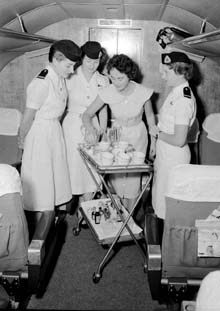
The Public Face of TAA
From the moment TAA began flying in 1946, its air hostesses became the public face of the airline. They represented professionalism, warmth and reliability at a time when air travel was still new to many Australians. Their role went far beyond serving meals — they were safety officers, first‑aid responders, ambassadors for the airline, and often the only woman on board.
TAA sought women with exceptional qualities: leadership ability, confidence, strong communication skills, and a calm presence under pressure. Many early hostesses had nursing or first‑aid qualifications, reflecting the airline’s emphasis on passenger safety and wellbeing.
Training was rigorous. Hostesses learned aircraft systems, emergency procedures, meteorology basics, passenger handling, etiquette, grooming standards and inflight service techniques. Although the early fleet consisted of only two aircraft types — the 21‑seat Douglas DC‑3 and the 40‑seat Douglas DC‑4 — the workload was demanding and required a high level of professionalism.
The DC‑4 was considered a large aircraft for its time and carried two hostesses. The smaller DC‑3 carried only one, making her responsible for every aspect of passenger comfort and safety.
On long‑haul DC‑4 flights to Perth — an 8‑hour journey — TAA introduced inflight music, a novelty that delighted passengers and helped pass the time. Hostesses managed the portable speakers, magazines, drinks and meal service, creating an experience that many travellers remembered fondly.
Here the hostess demonstrates seat placement and the positioning of a radio speaker — an early example of inflight entertainment. These small touches helped TAA build a reputation for thoughtful, passenger‑focused service.
Customer satisfaction was a central priority for the new airline. With long flight times and relatively small passenger numbers, hostesses had the opportunity to provide highly personalised service — something that became a hallmark of TAA’s identity.


A New Class of Travel
In 1947, TAA introduced recliner “sleeper” seats, transforming long journeys into a more comfortable experience. These seats could be adjusted for rest, allowing passengers to relax on overnight or cross‑country flights.
The early years of Australian commercial aviation are often remembered as the “golden age” of inflight service. Flight times were long — 3 to 3½ hours between Melbourne and Sydney, and up to 8 hours between Adelaide and Perth — giving hostesses ample time to interact with passengers, serve meals, and create a welcoming atmosphere.
Early aircraft flew between 5,000 and 8,000 feet, often below weather systems, which meant more turbulence and a more hands‑on role for hostesses. The arrival of the pressurised Convair 240 allowed flights at higher altitudes, reducing turbulence and enabling smoother service — but still with time for personal attention.
The introduction of the Vickers Viscount in 1954 brought both minor uniform changes and major changes to inflight service. The Viscount flew faster and higher, reducing flight times and requiring hostesses to adapt their routines to a more efficient service model.
In the mid‑1950s, TAA introduced “Tourist Class,” increasing seating capacity and redefining inflight service standards. First Class retained premium meals, silver‑service equipment and more spacious seating, while Tourist Class — the forerunner of today’s Economy Class — received simplified meals served in durable melamine crockery.
Although faster aircraft meant slightly less time for personalised service, TAA hostesses remained known for their friendliness, professionalism and attention to detail. Their ability to maintain warmth and hospitality under tighter schedules became a defining feature of the airline’s reputation.
By the 1960s and 70s, as TAA introduced jet aircraft such as the Boeing 727 and Douglas DC‑9, the role of the air hostess continued to evolve. Training expanded, safety responsibilities increased, and uniforms reflected contemporary fashion trends — but the core values of care, professionalism and service remained unchanged.