
Red Tape
By the mid‑1970s, it was becoming clear that the tightly controlled Two Airline Policy, which had once provided stability, was now limiting growth and flexibility in Australian aviation. Passenger numbers were rising, aircraft movements were increasing, and major airports such as Sydney and Melbourne were facing congestion and slot constraints.
The Airlines Agreement Act 1981 and related reforms marginally relaxed aspects of the policy. While the basic two‑airline structure remained, the Government began to explore more flexible arrangements to cope with increasing demand, new aircraft types and the growing interaction between domestic and international services.
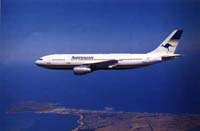
Under a newer, more liberal approach sometimes described as an “open skies” philosophy in domestic planning, TAA was finally able to introduce the wide‑body Airbus A300B4 into service in October 1981. This was a major breakthrough in the restrictions that had previously limited aircraft choice under the Two Airline Policy.
The A300B4 was revolutionary for the Australian domestic market — a twin‑engine, twin‑aisle wide‑body aircraft designed for short‑ to medium‑haul operations. It offered significantly more capacity than earlier narrow‑body types and allowed TAA to meet growing demand on the busy East Coast trunk routes and services to Perth.
The A300B4 could also carry substantial freight in its lower deck. Because its cargo holds were compatible with standard container systems used on Boeing 747s, overseas airlines could negotiate freight interline and on‑carriage agreements with TAA. This generated valuable additional revenue and integrated TAA more closely into global freight networks.
Around the same time, Ansett selected the Boeing 767 as its wide‑body aircraft of choice. The 767 and A300 became the new flagships of the two‑airline domestic system, symbolising a gradual shift away from the rigid constraints of the earlier policy.
In 1986, Trans‑Australia Airlines was controversially rebranded as Australian Airlines. Although the ownership and core operations remained the same, the familiar “Fly the Friendly Way” image was replaced with a more corporate identity, signalling that the airline was being prepared for a future in which government ownership would no longer be guaranteed.
By the late 1980s, it was widely accepted that the Two Airline Policy had outlived its usefulness. Economic reforms across many sectors, combined with growing public expectations of competition and choice, made a fully regulated duopoly increasingly difficult to justify.
The situation came to a head during the 1989 Australian pilots’ dispute, when the mass resignation of airline pilots and the use of replacement crews forced a complete re‑examination of how the industry was structured and regulated. The dispute accelerated changes that were already underway and hastened the move towards full deregulation.


QANTAS Merger
The early 1990s marked the final chapter for TAA/Australian Airlines as a separate entity. As part of broader micro‑economic reforms, the Australian Government decided that the national flag carrier and the domestic trunk‑route airline should be combined and then privatised.
In 1992, Qantas Airways and Australian Airlines were merged into a single organisation. This new structure combined Qantas’s international network with Australian’s extensive domestic routes, creating a unified national carrier.
The merged airline was then prepared for privatisation. In 1993, the Commonwealth Government sold a majority stake in Qantas to private investors, with British Airways acquiring a significant shareholding at the time. The new branding emphasised “QANTAS – The Australian Airline,” reflecting both its international role and its absorption of TAA/Australian Airlines’ domestic heritage.
Ansett, by then operating as a privately owned consortium, initially remained a strong competitor in the deregulated environment. It continued to expand its fleet and network, and for a time the post‑Two Airline era appeared to offer a healthy duopoly based on commercial rather than legislative foundations.
However, less than a decade after TAA’s identity disappeared into Qantas, Ansett collapsed in 2001 following a series of ownership changes, financial difficulties and strategic missteps. Its sudden grounding left a major gap in the domestic market and marked the end of the long‑running TAA/Ansett rivalry that had defined Australian aviation for nearly half a century.
With the demise of Ansett and the earlier end of the Two Airline Policy, the skies over Australia were finally free from the extensive controls that had once made the country’s aviation system unique. New carriers, new business models and new forms of competition emerged in the years that followed.
